> For the complete documentation index, see [llms.txt](https://docs.duplocloud.com/docs/llms.txt). Markdown versions of documentation pages are available by appending `.md` to page URLs; this page is available as [Markdown](https://docs.duplocloud.com/docs/automation-platform/overview-1/quick-start/create-a-service-with-gke-standard/step-4-create-a-load-balancer.md).
# Step 5: Create a Load Balancer
Creating a Load Balancer to configure network ports to access the application
Now that your DuploCloud Service is running, you have a mechanism to expose the containers and images in which your application resides. But because your containers are running inside a private network, you also need a load balancer to listen on the correct ports to access the application.
In this step, we add a Load Balancer Listener to complete this network configuration.
*Estimated time to complete Step 5: 10 minutes.*
## Prerequisites
Before creating a Load Balancer, verify that you accomplished the tasks in the previous tutorial steps. Using the DuploCloud Portal, confirm that:
* An [Infrastructure and Plan](/docs/automation-platform/overview-1/quick-start/step-1-infrastructure.md) exist, both with the name you created.
* The Infrastructure you created has [GKE Enabled](/docs/automation-platform/overview-1/quick-start/step-1-infrastructure.md).
* A [Tenant](/docs/automation-platform/overview-2/quick-start/step-2-tenant.md) with the name you chose has been created.
* A [Node Pool](broken://pages/30DoAjkzaRTATeeq673S) had been created.
* A [Service](/docs/automation-platform/overview-1/quick-start/create-a-service-with-gke-autopilot/step-3-create-app-via-k8s.md) with the name you chose has been created.
### Select the Tenant you created
In the **Tenant** list box, on the upper-left side of the DuploCloud Portal, select the Tenant that you created.
## Creating a Load Balancer
All containers are running inside a private network and cannot be accessed from an external network. To allow external access, create a Load Balancer:
1. In the DuploCloud Portal, navigate to **Kubernetes** -> **Services**. The **Services** page displays.
2. From the **NAME** column, select the name of your **Service**
3. Click the **Load Balancers** tab.
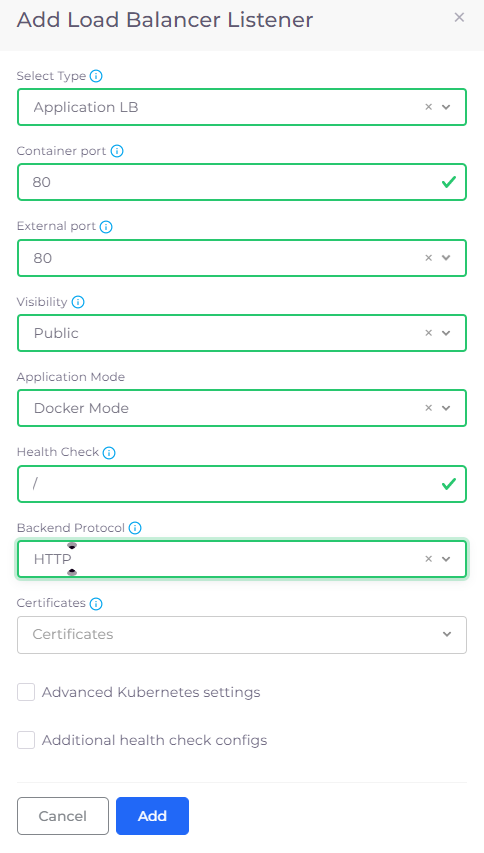
4. Click the **Configure Load Balancer** link. The **Add Load Balancer Listener** pane displays.
Add Load Balancer Listener pane
5. From the **Type** list box, select **Application LB**.
6. In the **Container Port** field, enter **80**. This is the configured port on which the application inside the Docker Container Image is running.
7. In the **External Port** field, enter **80**. This is the port through which users will access the web application.
8. From the **Visibility** list box, select **Public**.
9. From the **Application Mode** list box, select **Docker Mode**.
10. Type **/** (forward-slash) in the **Health Check** field to indicate that the cluster we want Kubernetes to perform Health Checks on is located at the `root` level.
11. In the **Backend Protocol** list box, select **HTTP**. HTTP is used for this tutorial since we are not setting up SSL certificates. However, using HTTPS to encrypt data between the user and the server when configuring Load Balancers is highly recommended. If you decide to use HTTPS, you must [configure SSL certificates](/docs/automation-platform/overview-1/prerequisites/certificate-for-load-balancer-and-ingress.md).
12. **Certificates:** You can leave this field empty, as SSL certificates are not necessary for this tutorial. However, we recommend using SSL certificates with Load Balancers to ensure secure HTTPS connections. If you'd like to add SSL certificates for your domain later, follow the instructions [here](/docs/automation-platform/overview-1/prerequisites/certificate-for-load-balancer-and-ingress.md).
13. Click **Add**. The Load Balancer is created and initialized. In approximately 2-3 minutes you will see the load balancer details available in the portal. The **LB Status** card displays **Ready** when the Load Balancer is ready.
## Checking your work
1. From the DuploCloud portal, navigate to **Kubernetes** -> **Services**.
2. Click on the name of your **Service**.
3. Verify that the **LB Status** card displays a status of **Ready**
Services details page showing a LB Status of Ready
---
# Agent Instructions
This documentation is published with GitBook. GitBook is the documentation platform designed so that both humans and AI agents can read, navigate, and reason over technical content effectively. Learn more at gitbook.com.
## Querying This Documentation
If you need additional information that is not directly available in this page, you can query the documentation by asking a question.
Perform an HTTP GET request on the following URL with the `ask` and `goal` query parameters:
```
GET https://docs.duplocloud.com/docs/automation-platform/overview-1/quick-start/create-a-service-with-gke-standard/step-4-create-a-load-balancer.md?ask=&goal=
```
`ask` is the immediate question: it should be specific, self-contained, and written in natural language.
`goal` is what the user is ultimately trying to achieve, the reason they need the answer. Sharing it helps GitBook give you a better, more relevant answer. A goal is most helpful when it describes the outcome the user wants rather than restating the question. For example, with `ask=how do I create an API token`, a goal like `automate deployments from our CI pipeline` lets GitBook tailor the answer to that use case.
The response will contain a direct answer to the question and relevant excerpts and sources from the documentation.
Use this mechanism when the answer is not explicitly present in the current page, you need clarification or additional context, or you want to retrieve related documentation sections.
.png?alt=media&token=901151a1-2ffd-42eb-9133-caa6cd2fbe38)