> For the complete documentation index, see [llms.txt](https://docs.duplocloud.com/docs/llms.txt). Markdown versions of documentation pages are available by appending `.md` to page URLs; this page is available as [Markdown](https://docs.duplocloud.com/docs/automation-platform/overview-2/prerequisites/connect-to-the-vpn.md).

# Connect to the VPN

DuploCloud integrates with OpenVPN by provisioning VPN users added to the DuploCloud Portal. As a DuploCloud user, you can access resources in the private network by connecting to the VPN with the OpenVPN client.

{% hint style="info" %}
The **OpenVPN Access Server** forwards traffic only to network resources within the DuploCloud-managed private networks. Any traffic intended for other resources on the internet does not pass through the VPN tunnel.
{% endhint %}

## Obtaining VPN Credentials

User VPN credentials are accessible through the user profile page.

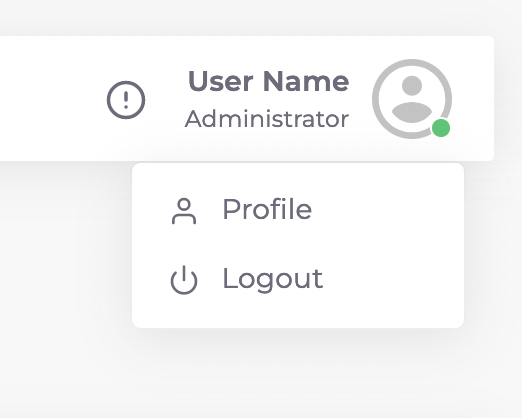
1. In the DuploCloud Portal, navigate to **Administrator** -> **Users** and select your user name, or click on the person icon (<img src="/files/MytTAis8dr1sqEgA1N8f" alt="" data-size="line">) in the upper-right corner, and select **Profile**.<br>

   <div align="left"><figure><img src="/files/aY35AXt7TCPvjeNk6bS2" alt="" width="261"><figcaption><p>The User menu</p></figcaption></figure></div>
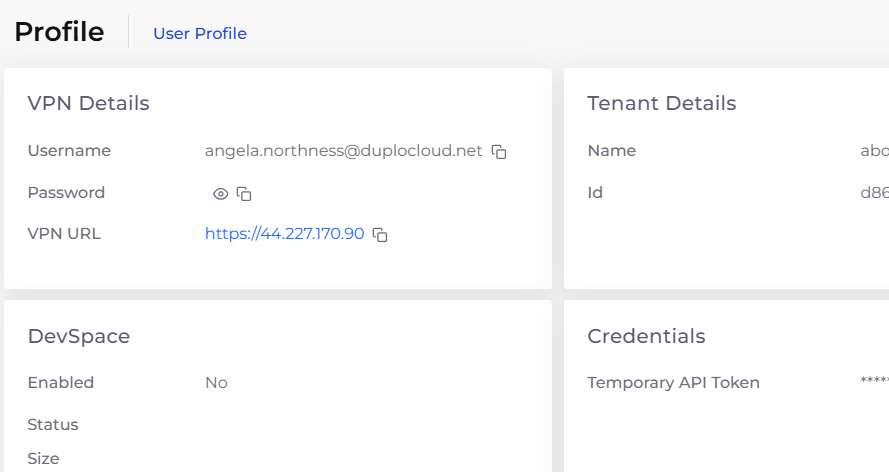
2. You will find your VPN credentials in the **VPN Details** section of your profile.

<div align="left"><figure><img src="/files/ckkreugPufSFHpjLM7vF" alt="" width="563"><figcaption><p>VPN Details section of the user profile</p></figcaption></figure></div>

## Setting up the OpenVPN User Profile and Client App

1. Click on the person icon (<img src="/files/MytTAis8dr1sqEgA1N8f" alt="" data-size="line">) in the upper right, and select **Profile**.
2. In the **VPN Details** section, click **VPN URL**. Your browser may flag the link as unsafe due to a self-signed certificate. Click **Proceed Anyway** to continue.
3. Log in to the **OpenVPN Access Server** user portal using the credentials from the DuploCloud user profile section.\
   \
   ![](/files/ZAyTgvF6gBn463xm2Tev)
4. Install the OpenVPN Connect app on your local machine.\
   \
   ![](/files/SMurCBNBCRg84eRUWzO5)
5. From the OpenVPN Access Server user portal, download your **user-locked profile** by clicking on the link labeled **Yourself** (this will generate the `.ovpn` file).\
   \
   ![](/files/z8Y8p4MPoQpO4GLNbnCo)
6. Open the `.ovpn` file and click **OK** in the **Import .ovpn profile** dialog box.
7. Once the profile is imported, click **Connect** to establish the VPN connection.\
   \
   ![](/files/bNZVCmORMhgCKLckGwe9)


---

# Agent Instructions
This documentation is published with GitBook. GitBook is the documentation platform designed so that both humans and AI agents can read, navigate, and reason over technical content effectively. Learn more at gitbook.com.

## Querying This Documentation
If you need additional information that is not directly available in this page, you can query the documentation dynamically by asking a question.

Perform an HTTP GET request on the current page URL with the `ask` query parameter, and the optional `goal` query parameter:

```
GET https://docs.duplocloud.com/docs/automation-platform/overview-2/prerequisites/connect-to-the-vpn.md?ask=<question>&goal=<endgoal>
```

`ask` is the immediate question: it should be specific, self-contained, and written in natural language.
`goal` is optional and describes the broader end goal you are ultimately trying to accomplish on behalf of the user. GitBook uses it to tailor the answer towards what is most useful for that goal.

The response will contain a direct answer to the question and relevant excerpts and sources from the documentation.

Use this mechanism when the answer is not explicitly present in the current page, you need clarification or additional context, or you want to retrieve related documentation sections.