> For the complete documentation index, see [llms.txt](https://docs.duplocloud.com/docs/llms.txt). Markdown versions of documentation pages are available by appending `.md` to page URLs; this page is available as [Markdown](https://docs.duplocloud.com/docs/automation-platform/kubernetes-overview/setting-up-probes.md).
# Probes and Health Check
Support for Kubernetes Probes
## Liveness, Readiness, and Startup Probes
{% hint style="danger" %}
Kubernetes probes can terminate pods and prevent pods from receiving traffic. They're powerful tools for managing availability, but they can be dangerous if they're tuned too tightly. Review the warnings in [this Kubernetes document](https://kubernetes.io/docs/tasks/configure-pod-container/configure-liveness-readiness-startup-probes/) before setting them.
{% endhint %}
Liveness, Readiness, and Startup probes are well-known methods to detect Pod health in Kubernetes. They are used in regular uptime monitoring and enable initial startup health that allows rolling deploys of new service updates.
The example below will define **Liveness, Readiness,** and **Startup probes** to one service deployment.
While creating a deployment, provide the below configuration to set up probes for your service.
# setup http livenessProbe
# To perform a probe, the kubelet sends an HTTPGET request
# Service is considered healthy when /healthz retuns success code
livenessProbe:
  httpGet:
    path: /healthz #endpoint path
    port: 8080
  initialDelaySeconds: 3  #first Liveness check to be performed after 3 seconds.
  periodSeconds: 3       #verify the liveness of the application every 3 seconds

# setup http readinessProbe
readinessProbe:
  httpGet:
    path: /healthz
    port: 8080
  initialDelaySeconds: 5
  periodSeconds: 5

# setup http startupProbe
startupProbe:
  initialDelaySeconds: 1
  periodSeconds: 5
  timeoutSeconds: 1
  successThreshold: 1
  failureThreshold: 1
  exec:
    command:
      - cat
      - /etc/nginx/nginx.conf
Other Container Config
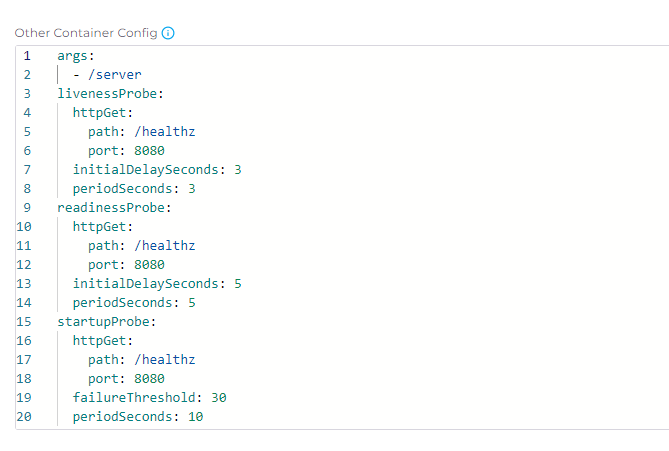
In addition to the `httpGet` example, TCP Probes can be configured from the **Other Container Config** field:
```yaml
readinessProbe:
tcpSocket:
port: 8080
initialDelaySeconds: 5
periodSeconds: 10
livenessProbe:
tcpSocket:
port: 8080
initialDelaySeconds: 15
periodSeconds: 20
startupProbe:
tcpSocket:
port: 8080
failureThreshold: 30
periodSeconds: 10
```
Complete details of this feature are available in the Kubernetes documentation [here](https://kubernetes.io/docs/tasks/configure-pod-container/configure-liveness-readiness-startup-probes/).
## Health Check
Enable Kubernetes Health by adding a [Load Balancer Listener with Health Check enabled](/docs/automation-platform/overview/aws-services/load-balancers.md#adding-a-load-balancer-listener).
---
# Agent Instructions
This documentation is published with GitBook. GitBook is the documentation platform designed so that both humans and AI agents can read, navigate, and reason over technical content effectively. Learn more at gitbook.com.
## Querying This Documentation
If you need additional information that is not directly available in this page, you can query the documentation by asking a question.
Perform an HTTP GET request on the following URL with the `ask` and `goal` query parameters:
```
GET https://docs.duplocloud.com/docs/automation-platform/kubernetes-overview/setting-up-probes.md?ask=&goal=
```
`ask` is the immediate question: it should be specific, self-contained, and written in natural language.
`goal` is what the user is ultimately trying to achieve, the reason they need the answer. Sharing it helps GitBook give you a better, more relevant answer. A goal is most helpful when it describes the outcome the user wants rather than restating the question. For example, with `ask=how do I create an API token`, a goal like `automate deployments from our CI pipeline` lets GitBook tailor the answer to that use case.
The response will contain a direct answer to the question and relevant excerpts and sources from the documentation.
Use this mechanism when the answer is not explicitly present in the current page, you need clarification or additional context, or you want to retrieve related documentation sections.